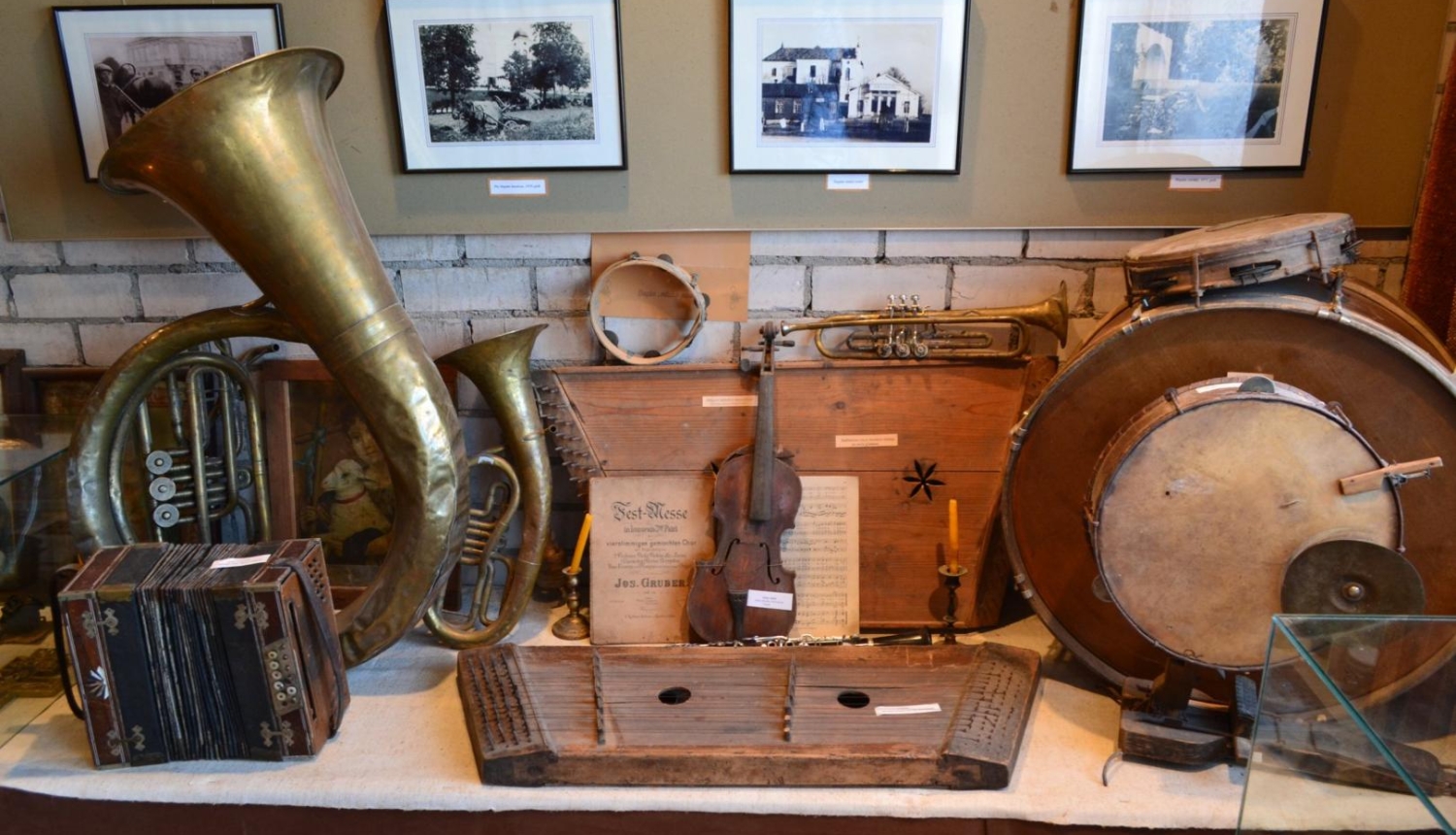
The Kraslava County Museum is located in the former servants’ house of the Palace Complex at Pils Street 8. The renovated stable building at Pils Street 10 consists of two exhibitions, two open collections and an exhibition hall. The collection of the museum contains 27 000 items that describe the peculiarity and uniqueness of the Kraslava region from the earliest of times to the present day. Among them – archaeological items, a large collection of ethnographic items documents, photographs, valuable 18th–19th century books and other collections, which are regularly exhibited in thematic exhibitions of the museum. The museum’s art collection contains over 1000 works of art by artists: Pāvils Glaudāns, Vanda Zēvalde, Vitālijs Kalvāns, Jāzeps Pīgožnis, Osvalds Zvejsalnieks, Inta and Kārlis Dobrāji, Pēteris Postažs, Valda Mežbārde, Leonīds Bauliņš, Valentīns Zlidnis, Daiga Lapsa, Nadīna Lavrecka and other artists. In the exhibition hall of the museum, a new exhibition of works of art is presented to the audience every two months for evaluation. Exhibitions of the works of Kraslava artists have become a tradition. In the museum, you can also familiarise yourself with thematic historical exhibitions.
Exhibition “Five Oars” (“Pieci airi”)
The museum offers a unique exposition created in a 17 m long improvised boat. Over the centuries, people of different nationalities have lived in Kraslava and its district, who have learned to live together, accepting the differences and looking for the common and have enriched each other with their culture, thus creating a special tolerance of peoples. In 1925, the coat of arms of the city of Kraslava was approved, which depicts a silver boat with five oars on a blue background. Five oars symbolised the nationalities living in Kraslava at that time: Latvians, Poles, Russians, Belarussians and Jews. The purpose of the exhibition “Five Oars” is to trace the interaction between these nationalities over the centuries, from the most ancient times to the present day.
Interior exhibition “Count Plater’s Notary Cabinet” (“Grāfa Plātera notāra kabinets”)
The exposition covers the period of the history of Kraslava from the 19th century until the end of the 20th century. In the 1920’s, when the history of Kraslava, which for almost 200 years was connected with the name of the Count Broel Plater’s dynasty, took a significant turn, as a result of which, the Platers’ lost their former power and influence in Latgale and left Kraslava. The exposition presents the fates of two families of Kraslava - Šarkovski and Rabinoviči. The authentic objects allow you to feel the atmosphere of that time, those belonging to Šarkovsku family: 19th century “H. Gentsch” grand piano, steward’s uniform buttons with the coat of arms of Count Broel Plater, faience and porcelain dishes from the Kuzņecova factory, the seal of the last owner of the Kraslava Palace - Countess Marija Stefania Anna Franciska Broel Plater and 19th century furniture and photographs.
Digital exhibition “Wood code.The Wooden Architectural Heritage of Kraslava” (“Koka kods.Krāslavas koka arhitektūras vērtības”)
The exhibition reveals the architectural heritage of the historic wooden houses of the Kraslava Municipality, and the craftsmanship created by their craftsmen. It demonstrates the architectural details of houses – gates, doors, verandas, windows and their decorative elements, which have created the characteristic appearance of wooden houses in rural areas and cities. The exhibition allows you to get acquainted with the wooden structures that were made with patience and skill and the delicate decorations that have given the buildings their authenticity. It is also complemented by a selection of tools, which helps to understand the working methods of craftsmen and the process of creating practical and decorative elements of the houses.
Exhibition “At one table” (“Pī vīna golda”)
It provides an opportunity to get acquainted with the culinary heritage of the nationalities living in the region, which has been preserved and put on the table from generation to generation. People of several nationalities have called Latgale their home for hundreds of years. The cuisine of the nationalities living in Latgale has been formed when traditional recipes met with the local Latgalian culinary customs, which then have been creatively transformed. Thanks to the responsiveness of the housewives of Kraslava region, it is possible to get acquainted with the culinary heritage of the nationalities living here, which has been preserved and put on the table from generation to generation, ensuring the preservation of recipes for future generations. The exposition covers the period from the beginning of the 20th century to the present day.
Exhibition “Workshop of the artist Valentīns Zlidnis” (“Mākslinieka Valentīna Zlidņa darbnīca”)
It is a story about the life and creative activity of V. Zlidnis, a colorful painter from Latgale. Here you can feel the artist’s creative spirit, listen to the fascinating sounds of Latvian kokle music, take a closer look at the artist’s work, which reveals the enchanting world of color art and the unique handwriting of V. Zlidnis. The animation “When the paintings come alive... The moods of Valentin Zlidnis artworks” is an unconventional insight into the artist’s work.
Collection “The Story of the Old House” (“Vecās mājas stāsts”)
Reflects the variety of household objects and the interior of the living space in the period from the end of the 19th century to the 70s of the 20th century. It is a story about the way of life, traditions and culture of previous generations. In the open collection, visitors have the opportunity to view 747 museum items, and this number is planned to be gradually increased. The objects have been collected in the Kraslava region, thanks to the responsiveness of the region’s residents, the desire to cooperate, preserve and pass on historical evidence to future generations.
Collection “The Heritage of the sculptor Vanda Zēvalde” (“Tēlnieces Vandas Zēvaldes mantojums”)
The collection of the Kraslava County Museum contains sculptures created by the sculptor V. Zēvalde, busts of famous cultural, artistic and political workers, large-scale sculptures as well as small sculptures, drawings, sketches and twills, as well as many documents, exhibition posters, catalogues, albums and photographs that capture her life and work. In total, 863 items are available for viewing in the open collection, which are placed on specially installed open shelves and large-format drawers, that ensure the conditions for storing and displaying works of art, as well as undeniably improve the public accessibility to the collection. In 2020, the open collection “Legacy of Sculptor Vanda Zēvalde” received the annual award of the Association of Latvian Museums.
Entrance fee:
4,00 EUR – adults,
2,00 EUR – pupils, students and seniors,
1,00 EUR – entrance fee per one exhibition,
6,00 - family ticket (1 or 2 adults 1 to 4 children under 18 years old).
Visiting the museum's exhibitions and displays is free of charge for people with disabilities, orphans and children deprived of parental care, politically repressed persons, employees of accredited Latvian museums, ICOM members (upon presenting a document confirming their status), and preschool-age children.
Working hours:
Summer season (15th May – 15th September)
Tuesday - Saturday: 10.00 – 18.00
Sunday: 10.00 - 16.00
Monday: Closed
Winter season (16th September – 14th May)
Working days: Tuesday – Friday: 10.00 – 17.00
Saturday: 10.00 - 15.00
Sunday, Monday : closed